Running a private 7 Days to Die server gives you a persistent world where friends can join without waiting for the host player. You can control the map, difficulty, Blood Moon frequency, loot settings, player limit, passwords, and server rules.
However, choosing a host based only on its advertised starting price can lead to poor performance. 7 Days to Die relies heavily on CPU speed and memory, especially when you generate a large world, install an overhaul mod, invite more players, or face a demanding Blood Moon.
This guide compares seven 7 Days to Die server hosting providers based on their published pricing, hardware, player limits, locations, mod access, backups, DDoS protection, control panel, support, and refund terms.
The comparison reflects provider documentation available in August 2026. It does not present provider marketing claims as independent benchmark results. Prices may also change based on location, billing term, slots, currency, and promotional discounts.
Affiliate disclosure: LinuxBuz may earn a commission when you purchase through links on this page, at no additional cost to you. Providers cannot pay to change their position in this comparison. Features and prices are checked independently, but you should confirm the final configuration at checkout.
Quick Comparison
| Provider | Price | Best For | Published Resources | Player Support | Refund Period |
|---|---|---|---|---|---|
| DatHost | €14.90/month | Best overall | 16 GB RAM, Ryzen 9-class CPU | Unlimited slots advertised | 14 days |
| GravelHost | $10.49/month | Transparent resources | 8 GB RAM, 2 vCores | Four players recommended | 72 hours |
| G-Portal | $12.45/month | Crossplay | NVMe storage | 6–30 PC slots; 6–8 console | Check current terms |
| Apex Hosting | $5.99/month | Beginners | 2 GB starter plan | Based on selected RAM | 7 days with conditions |
| ZAP-Hosting | €7.50/month | Flexible configurations | Configurable RAM and slots | Up to 200 advertised slots | Check current terms |
| Shockbyte | $11.99/month | Support documentation | Resources not clearly listed | Based on selected plan | 72 hours |
| HostHavoc | $10.00/month | Modded communities | NVMe storage | 8–64 slots | 72 hours |
Pricing note: The prices above are the comparison figures supplied for this article. Some provider pages display different promotional, regional, slot-based, or renewal prices. Confirm the final monthly cost before ordering.
How We Compared the Providers
The rankings use publicly available provider pages, terms, documentation, plan specifications, and support resources.
We considered:
- Published RAM and CPU allocation
- Player slots and recommended player counts
- Server locations
- DDoS protection
- Mod and FTP access
- Crossplay support
- Backup creation and restoration
- Control-panel functions
- Refund period
- Support availability
- Pricing transparency
- Suitability for beginners and experienced administrators
This is a documentation-verified comparison rather than a controlled performance benchmark. We have not published ping, CPU usage, support-response, or Blood Moon benchmark results because equivalent plans were not tested under identical conditions.
A future hands-on update should test the same world, game version, region, player count, mods, and Blood Moon settings on every host
What are the Best 7 Days to Die Game Server Hosting Services?
Let’s review each game server hosting in detail to see which one provides a server for the “7 Days to Die” game.
1. DatHost
Best overall for a powerful fixed-resource plan
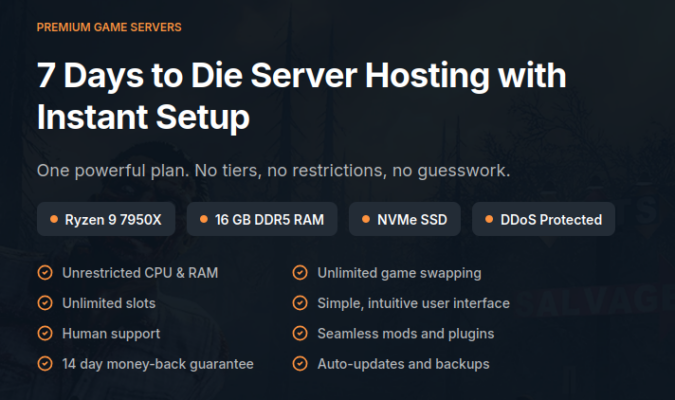
DatHost offers one main 7 Days to Die plan at €14.90 per month. The published configuration includes 16 GB of DDR5 RAM, a Ryzen 9 7950X or similar processor, NVMe storage, unrestricted resource use, DDoS protection, daily backups, automatic updates, file access, and unlimited advertised slots.
Its largest advantage is resource transparency. You do not need to compare many RAM tiers or calculate the cost of upgrades. DatHost also advertises a 14-day money-back guarantee and a broad network covering Europe, North America, Asia-Pacific, Latin America, India, Africa, and the Middle East.
The custom control panel includes server configuration and file management. Game switching is another useful feature when your group regularly moves between survival games.
What we like:
- 16 GB of published RAM
- High-frequency Ryzen-class hardware
- Daily backups and automatic updates
- Large location network
- 14-day refund period
- Simple all-inclusive plan
What could be better:
- No cheaper small-server tier
- Unlimited slots should not be treated as a performance guarantee
- Confirm console crossplay support before ordering
Choose DatHost if: You want a powerful plan without comparing multiple resource tiers.
2. GravelHost
Best for transparent RAM and vCPU allocations
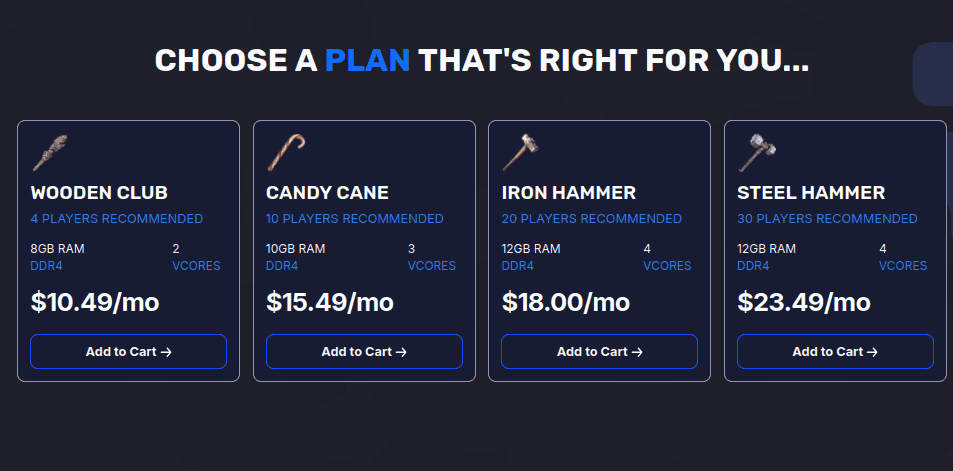
GravelHost is a good option when you want to know what resources you are buying. Its $10.49 Wooden Club plan includes 8 GB of RAM and two vCores, with four players recommended.
Larger plans increase the allocation to 10 or 12 GB of RAM and three or four vCores. GravelHost also publishes recommended player counts for its higher tiers instead of relying only on a maximum slot number.
Included features cover NVMe storage, FTP access, scheduled tasks, DDoS protection, a firewall manager, a custom control panel, and a 72-hour money-back period. Its locations cover North America, Asia, Australia, and Europe. The provider currently identifies its 7 Days to Die service as PC and Steam compatible.
What we like:
- Clear RAM and vCPU specifications
- Recommended player count for each tier
- Full FTP access
- Scheduled tasks and firewall controls
- Plans for small and larger groups
What could be better:
- Entry plan is recommended for only four players
- The refund window is limited to 72 hours
- Support is promoted mainly through Discord
- Console crossplay is not currently listed
Choose GravelHost if: You want transparent resources and a clear upgrade path.
3. G-Portal
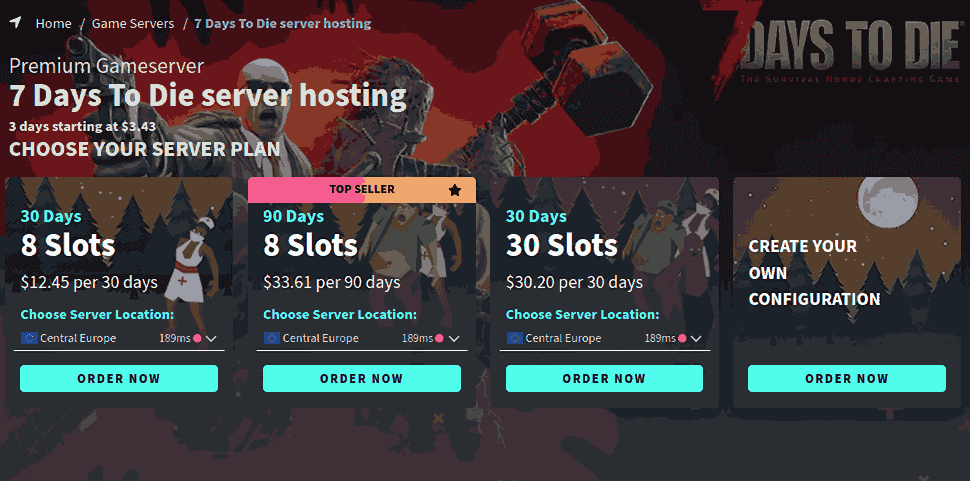
Best for PC and console crossplay
G-Portal is the strongest choice in this list for players who need documented crossplay support. Its current service supports PC, PlayStation 5, and Xbox connections, although crossplay configurations are limited to eight players.
PC plans support between 6 and 30 slots, while console plans offer 6 to 8 slots. G-Portal states that servers can become available in under three minutes. It also includes 50 GB of backup storage, NVMe hardware, ticket support, and DDoS protection through Bulwark and Corero.
The web interface lets beginners change common settings without editing every configuration file manually. FTP access remains available for advanced world management.
What we like:
- Clearly documented crossplay support
- Separate PC and console options
- 50 GB of backup storage
- Flexible short-term and monthly plans
- Established game-server control panel
What could be better:
- Crossplay is limited to eight players
- Prices change by slots, location, and rental period
- Refund information is not prominent on the product page
- Large PC communities need a higher slot configuration
Choose G-Portal if: Your group includes PC, Xbox, and PlayStation players.
4. Apex Hosting
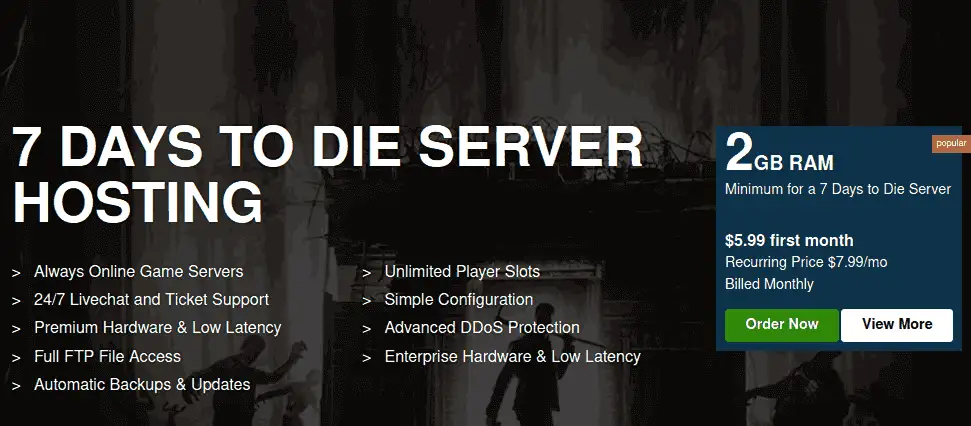
Best low-cost option for beginners
Apex Hosting offers a $5.99 introductory plan with 2 GB of RAM. The plan renews at a higher monthly price, so compare the first invoice with the recurring cost before ordering.
The web-based panel supports map changes, server settings, file access, updates, and mod installation. Apex also provides 24/7 live chat and ticket support, which may help first-time server owners who do not want to edit files through a command line.
Its infrastructure includes SSD storage, high-frequency CPUs, worldwide locations, DDoS mitigation, and a free server subdomain. The refund policy allows requests within seven days, but it contains conditions and excludes several one-time services.
What we like:
- Low introductory price
- Beginner-friendly control panel
- Live chat and ticket support
- Automatic updates
- Large tutorial library
What could be better:
- 2 GB is low for demanding or modded worlds
- Renewal price is higher than the first-month price
- Refund requests require a valid reason
- Larger RAM plans become more expensive
Choose Apex Hosting if: You are new to game-server administration and want guided support.
5. Zap Hosting
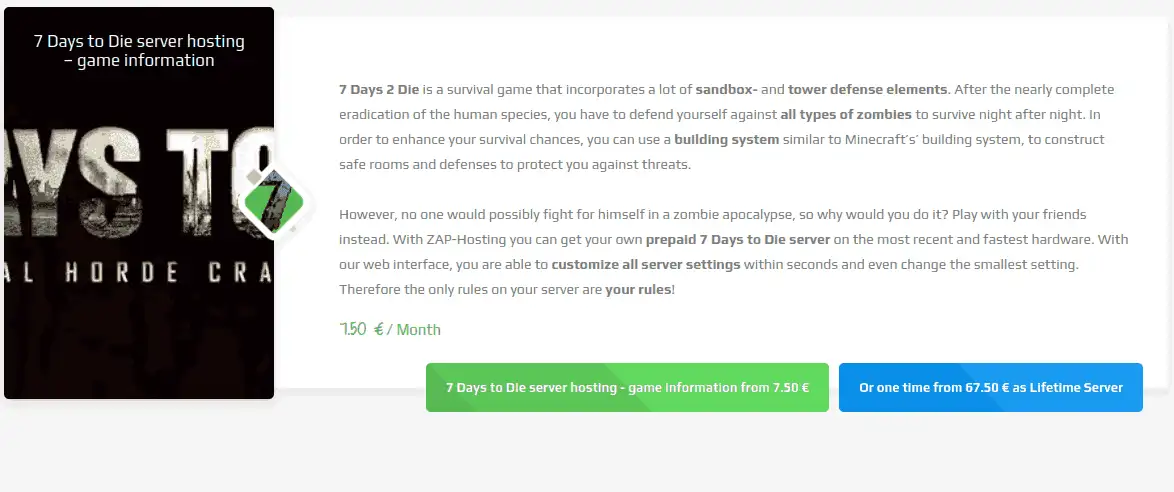
Best for flexible and prepaid configurations
ZAP-Hosting provides prepaid, contract, and lifetime server options. Its web interface lets you adjust slots, RAM, games, and other resources. It also supports FTP access, manual backups, game switching, DDoS protection, an in-game console, and an online configuration editor.
The provider offers vanilla, experimental, Oxide, and Darkness Falls server options. It advertises configurations with up to 200 slots, although actual performance still depends on the resources selected.
ZAP publicly lists Intel E5-2650 v4 processors on its product page. That hardware is older than the high-frequency Ryzen processors advertised by some competitors, so compare the final CPU and RAM configuration rather than focusing only on slot capacity.
What we like:
- Prepaid and lifetime payment choices
- Highly configurable plans
- FTP and configuration-file access
- Separate modded server options
- Game switching
What could be better:
- Pricing becomes complex after adding resources
- Publicly listed CPU generation is relatively old
- Location and hardware upgrades may add cost
- Refund terms need checking before payment
Choose ZAP-Hosting if: You want unusual billing options or a highly customized server.
6. Shockbyte
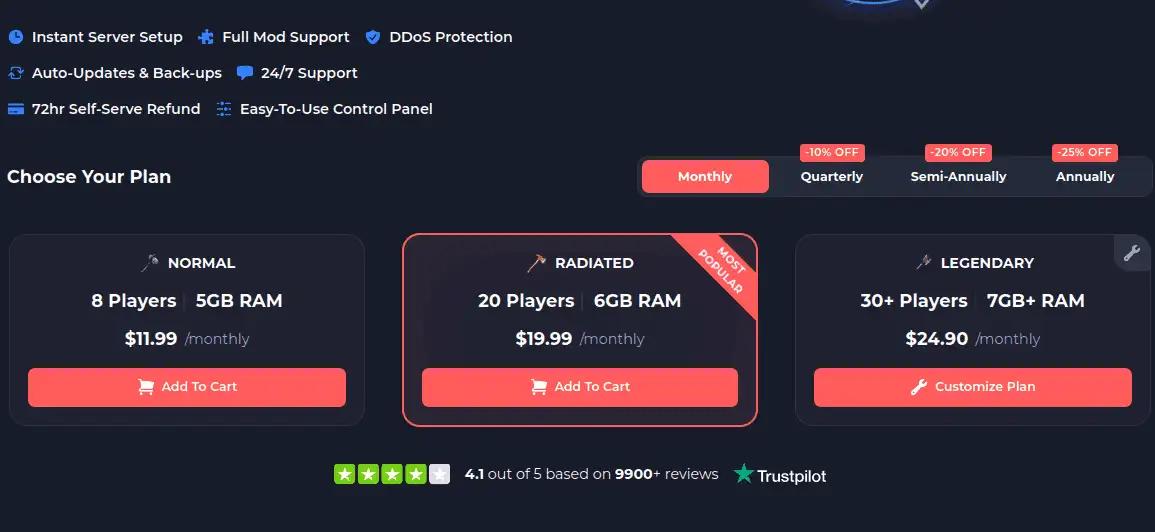
Best for guides and self-service support
Shockbyte combines an easy control panel with a large 7 Days to Die knowledge base. Its documentation covers world uploads, experimental branches, mods, Easy Anti-Cheat, admins, difficulty settings, PvP, bans, and configuration changes.
Published hosting features include full FTP access, mod support, automatic backups, automatic updates, DDoS protection, global locations, 24/7 support, a 99.9% uptime target, and a 72-hour self-service refund option.
Shockbyte supports tools and mod configurations such as Darkness Falls, but you should verify the RAM and CPU allocation for the exact $11.99 plan before purchasing.
What we like:
- Extensive setup documentation
- Full FTP access
- Automatic backups and updates
- Mod support
- Simple self-service refund process
What could be better:
- Refund window is only 72 hours
- Resource allocations are not clear on the main product page
- Promotional pricing can differ from the selected plan
- Published uptime is 99.9%, not 100%
Choose Shockbyte if: You prefer solving configuration issues through detailed guides.
7. HostHavoc
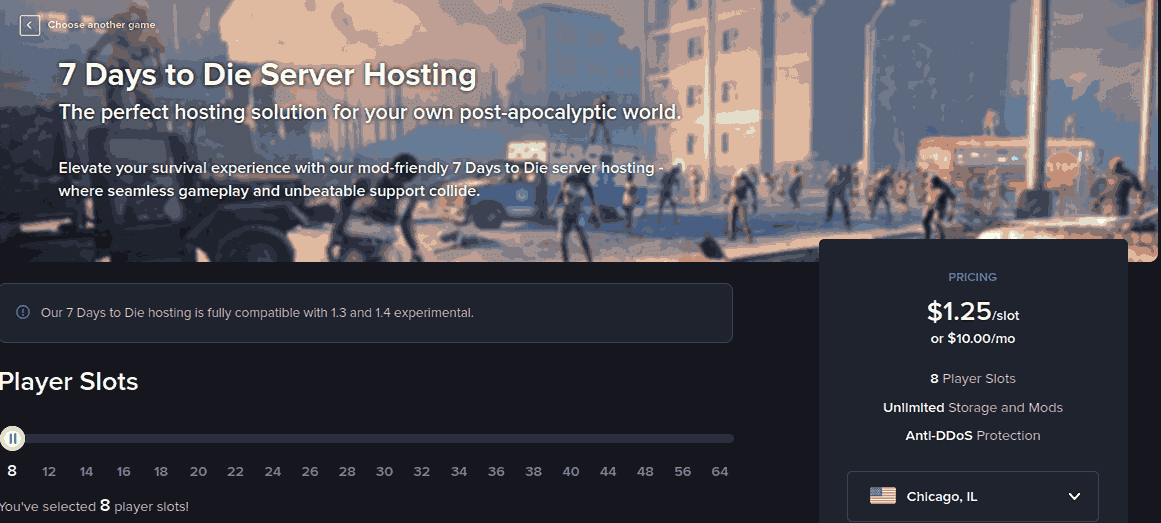
Best for modded servers and larger communities
HostHavoc supports server sizes from 8 to 64 slots. Its modified TCAdmin panel includes a web console, file manager, log viewer, workshop installer, off-site backups, and data restoration.
One-click installers are available for major mods such as Darkness Falls, War of the Walkers, and Ravenhearst. The provider also supports random world generation, experimental branches, Telnet, remote-access tools, automatic restarts, and custom configuration files.
Crossplay is available for vanilla servers with a maximum of eight players. Mods and crossplay cannot be used together because crossplay requires Easy Anti-Cheat and unchanged game files.
What we like:
- Strong mod and configuration support
- 8–64 slot choices
- Automated and manual backups
- Detailed game-specific documentation
- Crossplay support for vanilla servers
- 24/7 technical support
What could be better:
- Modded servers cannot use console crossplay
- Per-slot pricing rises with community size
- TCAdmin may look dated beside newer custom panels
- Large modpacks may require a higher-cost configuration
Choose HostHavoc if: You run a modded PC community or need advanced administrative access.
What to Look for in 7 Days to Die Hosting
RAM and CPU Allocation
A cheap plan is poor value when it lacks enough memory for your world. Vanilla servers for a few friends have lighter requirements than large maps or servers running Darkness Falls and similar overhaul mods.
Look for a high-frequency processor and at least 6–8 GB of RAM for a practical small server. Larger or heavily modded communities may require 12–16 GB or more. Read our 7 Days to Die server requirements guide before selecting a plan.
Slots Versus Recommended Players
An “unlimited slots” label does not mean that unlimited players can join without performance problems. The real limit depends on RAM, CPU allocation, world size, mods, entities, and player activity.
Give more weight to providers that publish a recommended player count for each resource tier.
Mods and Crossplay
Mods normally require file access, server configuration changes, and sometimes Easy Anti-Cheat to be disabled. Crossplay between PC, Xbox, and PlayStation requires compatible server settings and is limited to eight players in supported configurations. Modded PC servers and crossplay servers should therefore be treated as different use cases.
Backups and Refunds
Check whether backups are automatic, off-site, restorable through the control panel, and retained after cancellation. A backup that cannot be restored quickly has limited value.
Also read the refund policy instead of relying on a homepage badge. Some providers exclude add-ons, setup services, upgrades, or requests without a stated technical reason.
Managed Hosting or a VPS?
Managed game hosting is the easier choice for most players. The provider installs the game, maintains the panel, manages basic updates, and supplies DDoS protection and support.
A VPS gives you operating-system access and more control, but you must manage SteamCMD, firewall ports, backups, updates, monitoring, permissions, and security yourself. Read our guide on how to host a game server before choosing the VPS route.
Consider a VPS or dedicated server when you want to run several game instances, host additional services, or use custom automation that a managed panel does not support.
Final Verdict
DatHost is the best overall choice based on its published 16 GB RAM allocation, high-frequency processor, global locations, daily backups, and 14-day refund period.
Choose GravelHost when transparent RAM and vCPU tiers matter most. G-Portal is better for crossplay groups, while Apex suits beginners seeking a low initial price and live support.
ZAP-Hosting offers the most billing and configuration flexibility. Shockbyte stands out for self-service documentation, and HostHavoc is the strongest option for modded PC communities.
Before ordering, confirm the final price, renewal rate, server location, RAM, CPU allocation, backup policy, refund exclusions, and crossplay requirements. The right plan is not always the one with the lowest advertised price. It is the one that has enough resources for your world, mods, player count, and Blood Moon settings.
FAQs
A small vanilla server may work with 6–8 GB, while larger maps, more players, and overhaul mods can require 12–16 GB or more. CPU clock speed is also important during Blood Moon events. Most specialist hosts allow mods through FTP, file managers, or one-click installers. Confirm support for your exact mod and game version before paying. Compatible dedicated servers can support PC, Xbox, and PlayStation crossplay with a limit of eight players. Crossplay normally requires vanilla files and Easy Anti-Cheat. Apex has the lowest listed introductory price, but its entry plan includes limited RAM. GravelHost provides a clearer $10.49 configuration with 8 GB of RAM and two vCores. How much RAM does a 7 Days to Die server need?
Can I install mods on rented hosting?
Does 7 Days to Die hosting support crossplay?
What is the cheapest usable provider?
- 👉
- 👉
- 👉
- 👉
- 👉
- 👉
- 👉
- 👉
- 👉
- 👉
- 👉