
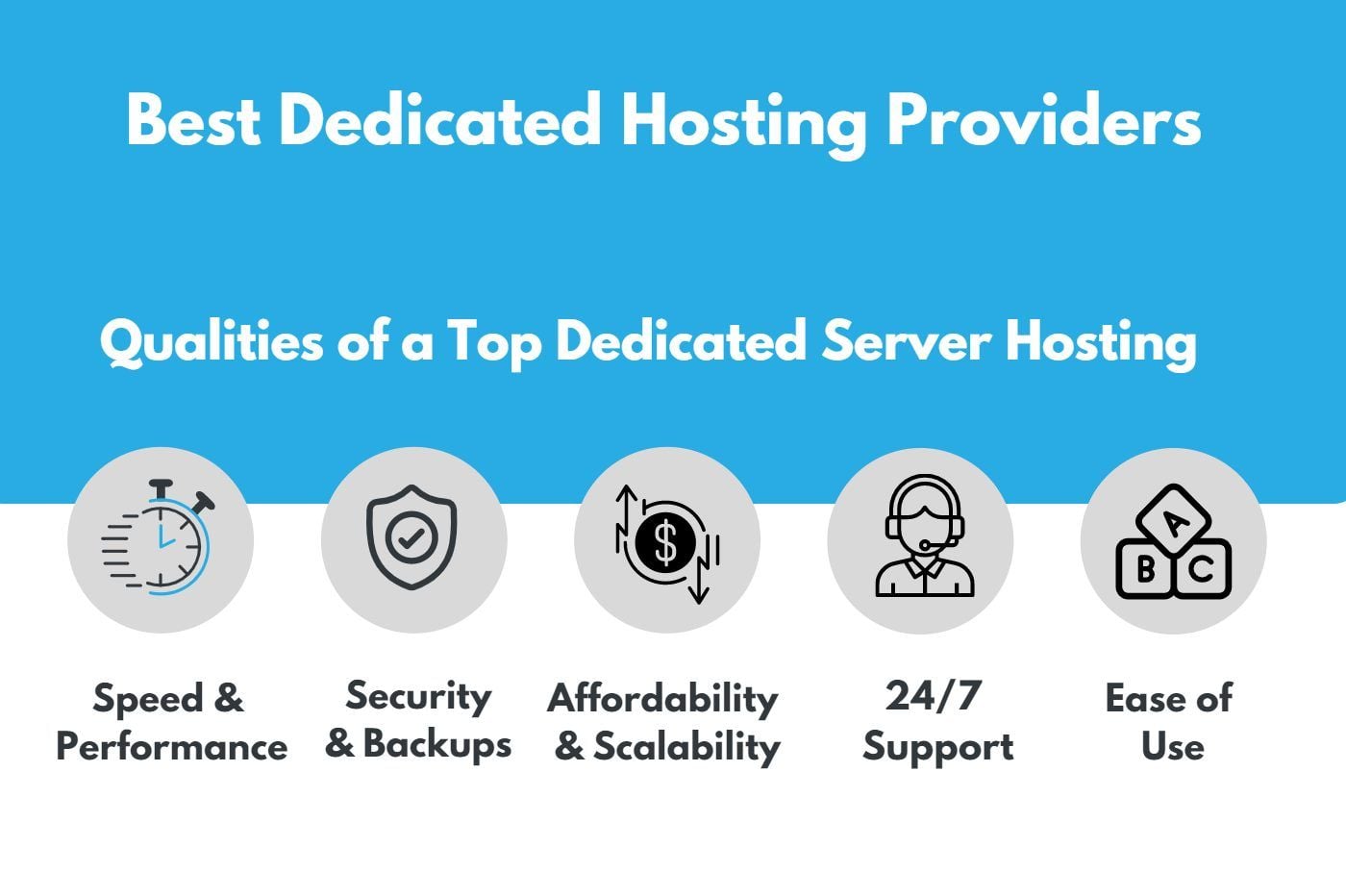
6 Top Dedicated Server Hosting Providers Compared for 2026

Best Dedicated Server Hosting

Dedicated server hosting gives you exclusive access to an entire physical server, with no shared CPU, memory, or storage. For businesses that need consistent performance, predictable costs, and full control over the server environment, dedicated hosting remains a strong choice in 2026.

As workloads grow more demanding, many teams move away from shared hosting and entry-level cloud plans. High-traffic websites, large databases, game servers, AI workloads, and compliance-driven applications often perform better on dedicated servers because resources stay reserved for a single customer. You avoid performance drops caused by other users and gain direct control over hardware, operating systems, and security settings.

Another reason dedicated servers continue to matter is pricing stability. While cloud costs can rise quickly under sustained usage, dedicated server pricing stays fixed month to month. This makes budgeting easier for production systems that run at steady load.

This guide highlights the 6 top dedicated server hosting providers for 2026, selected based on hardware range, network capacity, pricing clarity, and real-world reliability.

Best Dedicated Server Hosting – Quick Comparison Table

Before reviewing each provider in detail, this quick comparison table shows how the top dedicated server hosting providers in 2026 compare on pricing and core resource limits. It helps you narrow down options based on budget, memory needs, storage capacity, and bandwidth expectations.

ProviderStarting PriceRAM RangeStorage RangeBandwidth
Atlantic.Net$138 / month32–1000 GB960–32,000 GBUnlimited
Kamatera$19 / month1–128 GB20–4,000 GBNA
IONOS$41 / month16–96 GB1,000–4,000 GBUnlimited
OVHcloud$80 / month32–2,000 GB5,000–500,000 GBUnlimited
Liquid Web$44 / month16–120+ GB1,000–2,000 GB10 TB
Vultr$120 / month32–1,536 GB1,000–4,000 GB5–10 TB

Top 6 Dedicated Server Hosting Providers 2026

These providers stand out in 2026 for their dedicated hardware depth, network reliability, pricing transparency, and ability to support performance-critical production workloads without shared infrastructure.

1. Atlantic.Net

Atlantic.Net is a long-established dedicated server provider known for compliance-focused infrastructure and steady performance across enterprise and regulated environments.

Key Features

  • Fully dedicated physical servers with no shared resources

  • Wide RAM range suited for databases, analytics, and large applications

  • SSD and NVMe storage options with high capacity limits

  • Support for compliance needs such as HIPAA, HITECH, and PCI-DSS

  • Private networking and predictable throughput under sustained load

Best for: Organizations running compliance-driven workloads, databases, or high-traffic production systems that need stable performance.

Pricing

  • Starting price: $138 per month

  • RAM: 32–1000 GB

  • Storage: 960–32,000 GB

  • Bandwidth: Unlimited

2. Kamatera

Kamatera offers flexible dedicated server and cloud infrastructure options with customizable hardware, making it a practical choice for teams that want control over specs without long-term lock-ins.

Key Features

  • Dedicated servers with configurable CPU, RAM, and storage

  • Hourly and monthly billing options for cost control

  • Global data center locations for regional deployments

  • API access for automation and infrastructure management

  • Option to combine dedicated servers with cloud instances

Best for: Developers and businesses that need customizable dedicated servers with flexible billing and fast provisioning.

Pricing

  • Starting price: $19 per month

  • RAM: 1–128 GB

  • Storage: 20–4,000 GB

  • Bandwidth: NA

3. IONOS

IONOS provides dedicated server hosting with clear plans and predictable pricing, making it easy for businesses to deploy and manage dedicated hardware without unnecessary complexity.

Key Features

  • Dedicated servers with clearly defined hardware specifications

  • SSD-backed storage for steady disk performance

  • Unlimited bandwidth on most dedicated plans

  • Optional managed services for server administration

  • Data centers in North America and Europe

Best for: Small to midsize businesses and agencies that want dedicated servers with simple pricing and minimal setup overhead.

Pricing

  • Starting price: $41 per month

  • RAM: 16–96 GB

  • Storage: 1,000–4,000 GB

  • Bandwidth: Unlimited

4. OVHcloud

OVHcloud is known for its large-scale dedicated server infrastructure, offering a wide range of hardware configurations backed by its own global network and data centers.

Key Features

  • Broad selection of dedicated server configurations, from entry-level to high-capacity systems

  • High RAM and storage ceilings suitable for data-heavy workloads

  • Built-in DDoS protection included with dedicated servers

  • Global data centers across North America, Europe, and Asia-Pacific

  • Strong private backbone network for consistent throughput

Best for: Enterprises and fast-growing platforms that need powerful dedicated servers with strong network capacity and hardware choice.

Pricing

  • Starting price: $80 per month

  • RAM: 32–2,000 GB

  • Storage: 5,000–500,000 GB

  • Bandwidth: Unlimited

5. Liquid Web

Liquid Web focuses on dedicated server hosting with managed support, giving businesses access to physical servers without handling day-to-day system administration on their own.

Key Features

  • Dedicated servers with managed support options

  • SSD storage for faster application and database access

  • High RAM availability for memory-heavy workloads

  • 24/7 technical support with proactive monitoring

  • SLA-backed uptime and network reliability

Best for: Agencies and businesses that want dedicated servers with hands-on support and reduced operational workload.

Pricing

  • Starting price: $44 per month

  • RAM: 16–120+ GB

  • Storage: 1,000–2,000 GB

  • Bandwidth: 10 TB

6. Vultr

Vultr offers dedicated server hosting with a focus on global availability and high-resource configurations, suitable for workloads that need strong compute power across multiple regions.

Key Features

  • Dedicated physical servers with direct hardware access

  • High RAM ceilings for large databases and compute workloads

  • Multiple global data center locations

  • SSD-based storage for steady I/O performance

  • Simple billing with clear monthly pricing

Best for: Developers and enterprises that need powerful dedicated servers with worldwide deployment options.

Pricing

  • Starting price: $120 per month

  • RAM: 32–1,536 GB

  • Storage: 1,000–4,000 GB

  • Bandwidth: 5–10 TB

How to Choose the Best Dedicated Server?

The best dedicated server is the one that matches how your application behaves under real traffic, not just the highest specs on paper.

Start with CPU and RAM requirements. Applications like game servers and encoding tasks rely on CPU performance, while databases and analytics platforms depend more on memory. Choosing the right balance avoids paying for unused resources.

Next, look at storage type and capacity. SSD storage works well for applications that need fast read and write access. Larger disk volumes make more sense for backups, logs, and media-heavy workloads. Check whether upgrades are possible without a full server migration.

Bandwidth and network quality also matter. Some providers include unlimited transfer, while others set monthly limits. If your site or application serves global users, data center location and routing quality can affect latency more than raw bandwidth numbers.

Finally, consider pricing and support. Fixed monthly pricing suits long-running production systems. Managed support can reduce operational effort if your team is small, while self-managed servers give more control for experienced administrators.

Choosing carefully at the start helps avoid performance issues and unexpected costs later.

Use Cases for Dedicated Server Hosting

Dedicated servers are a practical choice when performance stability, hardware isolation, and cost predictability matter more than short-term flexibility.

High-traffic websites and applications
Websites with steady or peak-heavy traffic benefit from reserved CPU and memory. Dedicated servers keep response times consistent during traffic spikes and heavy background jobs.

Databases and data-heavy systems
Large MySQL, PostgreSQL, or NoSQL databases run more smoothly on dedicated hardware. Direct disk access and reserved memory reduce slow queries and I/O bottlenecks.

Game servers and real-time platforms
Multiplayer games, voice servers, and real-time applications depend on low latency and stable CPU access. Dedicated servers help maintain smooth gameplay and user experience.

Enterprise and compliance-driven workloads
Industries handling sensitive data often require single-tenant infrastructure. Dedicated servers simplify audits and reduce shared-risk exposure.

Virtualization and private infrastructure
Many teams use dedicated servers to host their own virtual machines, containers, or private platforms, keeping full control over the environment.

Dedicated server hosting fits workloads that need reliability day after day, not variable performance tied to shared resources.

Why Trust Our Recommendations

Our recommendations are built on independent research, clear criteria, and real-world usage patterns, not paid placements or vendor influence.

  • Verified data: Pricing, hardware ranges, bandwidth terms, and limits are checked against official provider documentation and updated for 2026.

  • Production-first view: We focus on how dedicated servers behave under sustained load—CPU stability, disk I/O, and network reliability—rather than short benchmarks.

  • Transparent trade-offs: Each provider’s strengths and limits are stated plainly so you can judge fit based on your workload.

  • No pay-to-rank: Inclusion and ordering are based on capability and value, not sponsorships.

  • Current relevance: The list reflects modern needs like automation, global deployment, and cost predictability.

If your infrastructure supports revenue or critical operations, these recommendations aim to help you choose with confidence beyond launch day.

How We Test and Rank Dedicated Server Providers

We rank dedicated server providers using a consistent, workload-focused process designed to reflect real production use.

  • Hardware capability: CPU options, RAM limits, storage types, and upgrade paths

  • Performance stability: CPU consistency, disk I/O behavior, and network reliability under sustained load

  • Network terms: Bandwidth limits, routing quality, and regional availability

  • Provisioning speed: Deployment time, rebuild options, and control panel or API access

  • Pricing clarity: Monthly costs, setup fees, and bandwidth overage policies

  • Support quality: Availability, response handling, and managed service options

Providers score higher when they deliver predictable performance, clear pricing, and reliable operations for common workloads like databases, high-traffic sites, game servers, and enterprise applications.

Conclusion

Dedicated server hosting remains a solid choice in 2026 for workloads that need consistent performance, full hardware access, and predictable monthly costs. When applications rely on steady CPU, memory, and disk performance, dedicated servers remove the uncertainty that comes with shared environments.

The providers listed in this guide serve different needs. Some focus on compliance and enterprise workloads, others on flexible pricing, managed support, or global availability. There is no single best provider for everyone. The right option depends on how your workload behaves, where your users are located, and how much control your team wants over the server environment.

Use the comparison table and provider breakdowns to shortlist options, then align them with your real usage patterns. When hardware resources, network limits, and support expectations match your workload, dedicated server hosting delivers long-term stability without unexpected cost swings.

 FAQs

1. What is dedicated server hosting?

Dedicated server hosting gives you full access to a physical server reserved for one customer. CPU, RAM, storage, and bandwidth are not shared with other users.

2. Who should use a dedicated server?

Dedicated servers work well for high-traffic websites, large databases, game servers, AI workloads, and applications that need steady performance or data isolation.

3. How is a dedicated server different from cloud hosting?

Cloud hosting uses shared infrastructure with virtual machines, while dedicated servers provide exclusive hardware access. Dedicated servers offer more predictable performance under constant load.

4. What is the average cost of a dedicated server?

Dedicated server pricing usually starts around $40–$150 per month and increases with higher RAM, storage, and bandwidth. Costs remain fixed, which helps with long-term budgeting.

About Hitesh Jethva

Experienced Technical writer, DevOps professional with a demonstrated history of working in the information technology and services industry. Skilled in Game server hosting, AWS, Jenkins, Ansible, Docker, Kubernetes, Web server, Security, Proxy, Iptables, Linux System Administration, Domain Name System (DNS), and Technical Writing.

View all posts by Hitesh Jethva

Leave a Reply

Your email address will not be published. Required fields are marked *