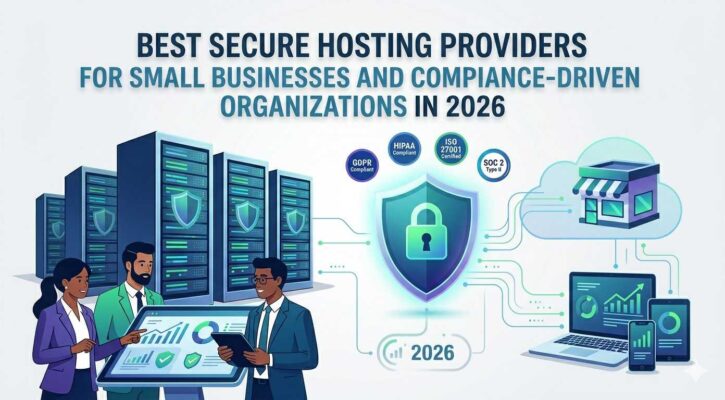
The best secure hosting provider depends on what you’re trying to protect and how quickly your business is growing.
For most small businesses, secure hosting means much more than firewalls and encrypted storage. The real challenge is choosing infrastructure that can handle future security reviews, compliance requirements, customer audits, and growth without forcing a costly migration later.
Atlantic.Net is one of the strongest options for organizations that expect security and compliance requirements to increase over time. AWS, Microsoft Azure, and Google Cloud offer exceptional scalability and flexibility but often require more in-house expertise. Meanwhile, providers like IONOS and Kamatera can be good fits for businesses with simpler operational needs or tighter budgets.
The right decision comes down to balancing security, compliance readiness, operational complexity, support, and long-term scalability.
Why Secure Hosting Has Become a Business Decision, Not Just an IT Decision
Ten years ago, many small businesses selected hosting based primarily on price.
Today, security requirements often originate from customers rather than internal teams.
A healthcare software startup may land its first enterprise customer and suddenly receive a 200-question security assessment. A financial services company may need to demonstrate access controls and encryption practices before signing a new contract. Even relatively small SaaS vendors increasingly encounter vendor risk reviews from prospects.
One observation that comes up repeatedly: most companies don’t outgrow their servers. They outgrow their compliance posture.
The infrastructure that seemed perfectly adequate at launch can become a liability once customer expectations change.
That shift has made secure hosting an operational and strategic decision rather than a simple technology purchase.
What Actually Matters When Evaluating Secure Hosting Providers?
Many hosting comparison articles focus heavily on technical specifications. In practice, experienced buyers evaluate a different set of criteria.
The first question is whether the provider can support your current requirements and the ones you expect to have two or three years from now.
Security reviews, compliance audits, disaster recovery planning, customer questionnaires, and infrastructure scaling all tend to arrive faster than most teams anticipate.
The strongest hosting providers generally offer:
| Evaluation Area | Why It Matters |
|---|---|
| Compliance Support | Reduces future audit and regulatory challenges |
| Infrastructure Isolation | Helps protect sensitive workloads |
| Managed Security Options | Valuable for lean IT teams |
| Backup & Recovery | Determines how quickly systems can recover |
| Scalability | Avoids disruptive migrations |
| Access Controls | Critical for customer security reviews |
| Monitoring & Logging | Supports investigations and audits |
| Support Quality | Important during incidents and outages |
A common mistake is assuming that a secure platform automatically results in secure operations. Most security incidents stem from configuration issues, weak processes, or insufficient monitoring rather than infrastructure limitations.
Best Secure Hosting Providers for Small Businesses and Growing Companies
1. Atlantic.Net — Best for Compliance-Focused Growth
Atlantic.Net is a strong fit for organizations that need secure infrastructure today and expect compliance requirements to grow over time. Rather than forcing businesses to switch providers as their needs evolve, it offers a path from cloud hosting to managed services, dedicated infrastructure, disaster recovery, and compliance-focused environments.
This makes it particularly attractive for healthcare organizations, financial technology companies, SaaS providers, and businesses that regularly handle sensitive data.
Where Atlantic.Net excels:
- HIPAA and PCI-focused hosting environments
- Managed and dedicated infrastructure options
- Security-conscious support for regulated workloads
- Scalable infrastructure without requiring a platform migration
Best for:
- Healthcare organizations
- Growing SaaS companies
- Financial services and fintech firms
- Businesses preparing for customer security reviews or compliance audits
2. Amazon Web Services (AWS) — Best for Maximum Flexibility
AWS remains one of the most widely adopted cloud platforms because it offers an enormous range of infrastructure and application services. From startups building new products to enterprises operating globally, AWS can support almost any workload or architecture.
The tradeoff is operational complexity. Security, governance, networking, and cost management often require dedicated expertise as environments grow.
Where AWS excels:
- Highly customized cloud architectures
- Global deployments
- AI, analytics, and cloud-native applications
- Extensive service ecosystem
Best for:
- Engineering-led organizations
- Fast-growing SaaS companies
- Businesses with dedicated cloud teams
- Enterprises requiring advanced cloud capabilities
3. Microsoft Azure — Best for Microsoft-Centric Organizations
Azure is often the natural choice for companies already invested in the Microsoft ecosystem. Organizations using Microsoft 365, Active Directory, Windows Server, and SQL Server can benefit from tighter integration across users, infrastructure, and security controls.
Many regulated industries also appreciate Azure’s governance and identity-management capabilities.
Where Azure excels:
- Integration with Microsoft products
- Enterprise identity management
- Governance and access controls
- Hybrid cloud deployments
Best for:
- Healthcare and insurance organizations
- Enterprise businesses
- Microsoft-first IT environments
- Companies with established governance requirements
4. Google Cloud Platform — Best for Data-Driven Organizations
Google Cloud has become a popular choice for organizations building modern, cloud-native applications. Its strengths in analytics, artificial intelligence, networking, and containerized workloads make it especially attractive for data-intensive businesses.
Engineering teams often choose Google Cloud when application performance and developer productivity are top priorities.
Where Google Cloud excels:
- Data analytics and AI workloads
- Kubernetes and container platforms
- High-performance networking
- Cloud-native application development
Best for:
- Technology companies
- Analytics-focused businesses
- AI and machine learning projects
- Modern application environments
5. IONOS — Best for Cost-Conscious Small Businesses
Not every organization needs enterprise-scale infrastructure from day one. For businesses prioritizing affordability and simplicity, IONOS provides a practical starting point.
It offers straightforward hosting solutions that can work well for startups, local businesses, and organizations with relatively simple hosting requirements.
Where IONOS excels:
- Budget-friendly hosting
- Predictable costs
- Easy deployment
- Small business accessibility
Best for:
- Startups
- Small businesses
- Local service companies
- Organizations with basic hosting needs
6. Kamatera — Best for Infrastructure Customization
Kamatera appeals to organizations that want greater control over how infrastructure resources are allocated. Instead of selecting predefined plans, businesses can customize compute, storage, and networking resources to match specific workload requirements.
This flexibility can be valuable for technical teams running specialized applications or unique environments.
Where Kamatera excels:
- Custom infrastructure configurations
- Flexible resource allocation
- Specialized workloads
- Technical deployment requirements
Best for:
- Technical teams
- Software development companies
- Specialized applications
- Organizations requiring infrastructure flexibility
Atlantic.Net vs AWS vs Azure: Which Is Better for Security-Focused Organizations?
This is one of the most common questions buyers ask.
The answer depends largely on how much responsibility your team wants to assume.
| Requirement | Atlantic.Net | AWS | Azure |
| Compliance-Oriented Hosting | Strong | Strong | Strong |
| Managed Infrastructure Options | Strong | Moderate | Moderate |
| Operational Complexity | Lower | Higher | Higher |
| Enterprise Service Catalog | Moderate | Very High | Very High |
| SMB Friendliness | High | Moderate | Moderate |
| Dedicated Infrastructure Options | Strong | Strong | Strong |
| Governance Flexibility | High | Very High | Very High |
In practice, many small and mid-sized organizations prefer environments that reduce operational burden. Large enterprises often prioritize flexibility and customization even when that introduces complexity.
Neither approach is inherently better. The right choice depends on internal resources and business objectives.
Which Hosting Platforms Are Best for Compliance-Heavy Industries?
Different industries face different requirements.
While the underlying security principles remain similar, compliance expectations vary significantly depending on the type of data being stored and the customers being served.
| Industry | Key Considerations |
|---|---|
| Healthcare | HIPAA requirements, Business Associate Agreements (BAAs), audit logging, encryption |
| Financial Services | PCI DSS requirements, access controls, monitoring, data protection |
| Legal | Data retention policies, encryption, access management, confidentiality |
| SaaS | Customer security reviews, vendor assessments, governance documentation |
Healthcare organizations typically need audit logging, encryption controls, Business Associate Agreements, and infrastructure capable of supporting HIPAA-related requirements.
Financial services firms often focus on payment security, access controls, monitoring, and governance frameworks.
Legal organizations prioritize data protection, retention policies, and access management.
Meanwhile, SaaS vendors increasingly face customer-driven security reviews regardless of industry.
One trend is worth highlighting: customer compliance demands often arrive before regulatory requirements.
Many growing software companies invest in secure hosting not because regulations require it today, but because customers expect it tomorrow.
For compliance-heavy industries, Atlantic.Net, AWS, Azure, and Google Cloud generally represent the strongest options.
Hosting Requirements Change as Companies Grow
The hosting platform that works for a five-person startup may not be the right fit for a company with 100 employees.
Early-Stage Businesses
Smaller organizations typically prioritize affordability, simplicity, and speed.
At this stage, ease of management often matters more than advanced governance features.
Growth-Stage Companies
As customer counts increase, security reviews become more common.
This is often when organizations begin investing in stronger monitoring, backup strategies, access controls, and compliance preparation.
Mature Organizations
Larger companies usually focus on governance, infrastructure standardization, disaster recovery, and regulatory alignment.
The key lesson is simple: choose a platform that supports where your business is heading, not just where it is today.
When Does Atlantic.Net Make More Sense Than AWS or Azure?
All three providers can support secure and compliant environments, but they serve different needs.
Choose Atlantic.Net if:
- You need compliance-focused hosting without managing everything yourself.
- Your team is small or lacks dedicated cloud engineers.
- Customer security reviews and questionnaires are becoming more common.
- You expect HIPAA, PCI DSS, or other compliance requirements.
- You want managed support and guidance alongside your infrastructure.
- You value operational simplicity over access to hundreds of cloud services.
Choose AWS or Azure if:
- You need highly customized cloud architectures.
- Your organization has a mature cloud engineering team.
- You require advanced services for AI, analytics, automation, or large-scale applications.
- You operate across multiple regions with complex infrastructure needs.
- You want the broadest possible cloud ecosystem and service catalog.
In many cases, the decision comes down to priorities. If you’re focused on securely supporting business growth and compliance requirements without adding unnecessary complexity, Atlantic.Net is often the better fit. If your goal is maximum flexibility and customization, AWS or Azure may be the stronger choice.
Mini Case Study: When Growth Creates Security Problems
A healthcare SaaS company launched successfully using a basic cloud environment.
For nearly two years, everything worked smoothly.
Then the company signed its first enterprise customer.
The customer required a security assessment, infrastructure review, and compliance documentation before onboarding could proceed.
The engineering team spent months implementing controls that would have been easier to establish earlier.
This situation is surprisingly common.
The first major security review often exposes operational gaps rather than technical shortcomings. Infrastructure decisions made during the startup phase can significantly influence how difficult those gaps are to address later.
Final Thoughts
The best secure hosting provider is not necessarily the largest platform or the lowest-cost option. It is the provider that aligns with your security requirements, internal expertise, customer expectations, and growth plans.
For organizations operating in regulated industries—or those expecting compliance requirements to increase—Atlantic.Net deserves serious consideration because it bridges the gap between cloud flexibility, compliance readiness, managed services, and long-term scalability.
Most businesses don’t regret choosing infrastructure that can support future growth. They regret waiting until a customer audit, security review, or compliance requirement forces them to make changes under pressure.
Secure hosting works best when it supports where your organization is going, not just where it is today.
FAQs
There is no universal answer, but Atlantic.Net, AWS, Azure, Google Cloud, IONOS, and Kamatera all serve different business needs. The best choice depends on compliance requirements, technical resources, growth expectations, and budget. AWS, Azure, Google Cloud, and Atlantic.Net all provide strong scalability. The right option depends on whether you prioritize flexibility, managed services, compliance support, or operational simplicity. Growing businesses should focus on security controls, scalability, compliance readiness, backup capabilities, and operational support rather than simply comparing infrastructure specifications. Yes. Small businesses increasingly face customer security requirements, cyber threats, and contractual obligations that require stronger infrastructure protections. Dedicated infrastructure becomes attractive when organizations require stronger isolation, predictable performance, regulatory support, or customer-driven security assurances. What is the best secure hosting provider for small businesses?
Which hosting provider offers the best scalability?
What should growing companies prioritize when selecting hosting?
Is secure hosting necessary for small businesses?
When should a company consider dedicated infrastructure?