
Choosing the right web hosting is critical to your website’s stability, visibility, and long-term growth. Most mainstream providers operate under strict copyright frameworks like the Digital Millennium Copyright Act (DMCA), meaning they are required to respond to takedown requests—sometimes quickly and without much investigation. For site owners working with sensitive, user-generated, or controversial content, this can create risk.
As a result, many are exploring alternatives such as DMCA Ignored hosting and Offshore hosting, which offer different levels of flexibility and jurisdictional protection. While these options can reduce the likelihood of sudden content removal, they are not “anything goes” solutions. Each provider still enforces its own acceptable use policies and legal boundaries.
Understanding the real differences between DMCA Ignored hosting and Offshore hosting helps you choose a setup that aligns with your content strategy, risk tolerance, and compliance needs—without exposing your site to unnecessary downtime or legal complications.
Table of Contents
What is DMCA Ignored Hosting?
DMCA Ignored hosting is a specific type of hosting service where the provider intentionally does not act on DMCA takedown requests sent under the Digital Millennium Copyright Act (DMCA). Unlike traditional hosting, which quickly removes content upon receiving a complaint from copyright holders, this hosting service allows your site to remain online.
This approach gives website owners more control over their content without the immediate threat of removal due to copyright claims. The hosting provider essentially creates a buffer against legal action from copyright holders, though it doesn’t eliminate all risks. While offshore hosting may allow more flexibility compared to traditional providers, you cannot host just any type of content—offshore hosting services still have their own policies and may prohibit illegal, harmful, or extremely high-risk material. In the following sections, we will explore its core features and how it handles these requests.
Definition and Core Features of DMCA Ignored Hosting
At its core, DMCA Ignored hosting is a web hosting service that operates from jurisdictions where U.S. copyright laws, specifically the DMCA, are not enforced. This means when a copyright holder files a DMCA takedown request against your site, the hosting provider is not obligated to comply, and often won’t. This setup is designed to protect site owners from having their content forcibly removed.
This type of service is particularly appealing to those who value freedom of speech and want to host content that might be considered controversial or attract frequent complaints. It provides a shield against what some see as ambiguous or aggressive takedown notices, giving you more stability.
However, it’s important for site owners to understand that this doesn’t offer complete immunity from legal consequences. While the hosting service may ignore the requests, copyright holders can still pursue other forms of legal action. It simply removes the immediate threat of your site going down due to a DMCA notice.
How DMCA Ignored Hosting Responds to Takedown Requests
When a standard hosting provider receives DMCA takedown requests, the typical response is swift compliance, often resulting in your content being removed immediately. In contrast, a DMCA Ignored hosting provider handles copyright complaints very differently due to its location and policies, which are designed to resist weak copyright claims.
Instead of automatically acting on takedown notices, these providers employ a few different strategies to protect your website. This approach is central to their service and is the main reason clients choose them over providers with stricter copyright enforcement. Their response usually falls into one of the following categories:
When selecting a reliable offshore DMCA Ignored hosting provider, it’s important to research their reputation, customer reviews, and history of responding to takedown requests. Look for transparency in their terms of service, responsive customer support, and a proven track record of actually providing DMCA Ignored hosting rather than merely advertising it. Ensuring the provider operates in a jurisdiction with strong privacy and free speech protections can also contribute to the reliability and effectiveness of their services.
- Ignoring the complaint: Many providers will simply ignore the DMCA request entirely, as they are not legally bound to act on it.
- Challenging the request: Some may require the copyright holder to provide substantial legal proof of infringement before considering any action.
- Notifying the owner: A provider might forward the complaint to you, the website owner, allowing you to handle it without taking direct action themselves.
This resistance to automatic content removal protects your site from downtime caused by copyright claims. While it doesn’t make you immune to legal action, it ensures your site isn’t taken offline by the hosting provider based on DMCA requests alone.
What is Offshore Hosting?
Offshore hosting refers to a hosting setup where your website’s data is stored in a country different from your own. For example, a U.S.-based website owner using servers located in the Netherlands, Switzerland, or Malaysia is using offshore web hosting.
The main advantage of offshore hosting is access to a different legal environment. Some countries offer more flexible copyright laws, stronger data protection regulations, or enhanced privacy protections compared to the United States. This can help website owners manage content and business data under a framework that better fits their needs.
Offshore Hosting Explained for U.S. Website Owners
For U.S.-based businesses or publishers, offshore hosting means your website data is physically stored and managed outside U.S. jurisdiction. This creates a layer of separation from U.S. laws, including those related to copyright enforcement, data access, and content restrictions.
Many offshore hosting providers operate in countries known for strong privacy laws and business-friendly regulations. By choosing an offshore VPS or dedicated server, you effectively place your website under a different legal system.
This setup can be useful if:
- Your content is sensitive or frequently challenged
- You want stronger data privacy protections
- You prefer reduced exposure to U.S.-based legal processes
In simple terms, offshore hosting allows you to align your website with a juriVPSsdiction that supports your content strategy and operational goals more effectively.
Typical Reasons for Choosing Offshore Hosting
Website owners choose offshore hosting for several practical and strategic reasons. The decision is usually driven by the need for more control, privacy, and flexibility than what domestic hosting providers offer.
One of the most important benefits is enhanced data privacy. Many offshore jurisdictions have strict privacy regulations, and some providers support anonymous registration or cryptocurrency payments, adding another layer of protection for user identity.
Other common motivations for choosing offshore hosting include:
- Freedom of speech
Hosting in regions with strong free speech protections allows publishing content that may be restricted or flagged in stricter jurisdictions. - Stronger data protection
Some countries enforce tighter data protection laws, helping safeguard both business and user information. - Reduced legal exposure
Operating under a different legal jurisdiction can lower the risk of facing certain copyright claims or regulatory actions common in your home country.
DMCA Ignored vs Offshore Hosting: Comparing Key Differences
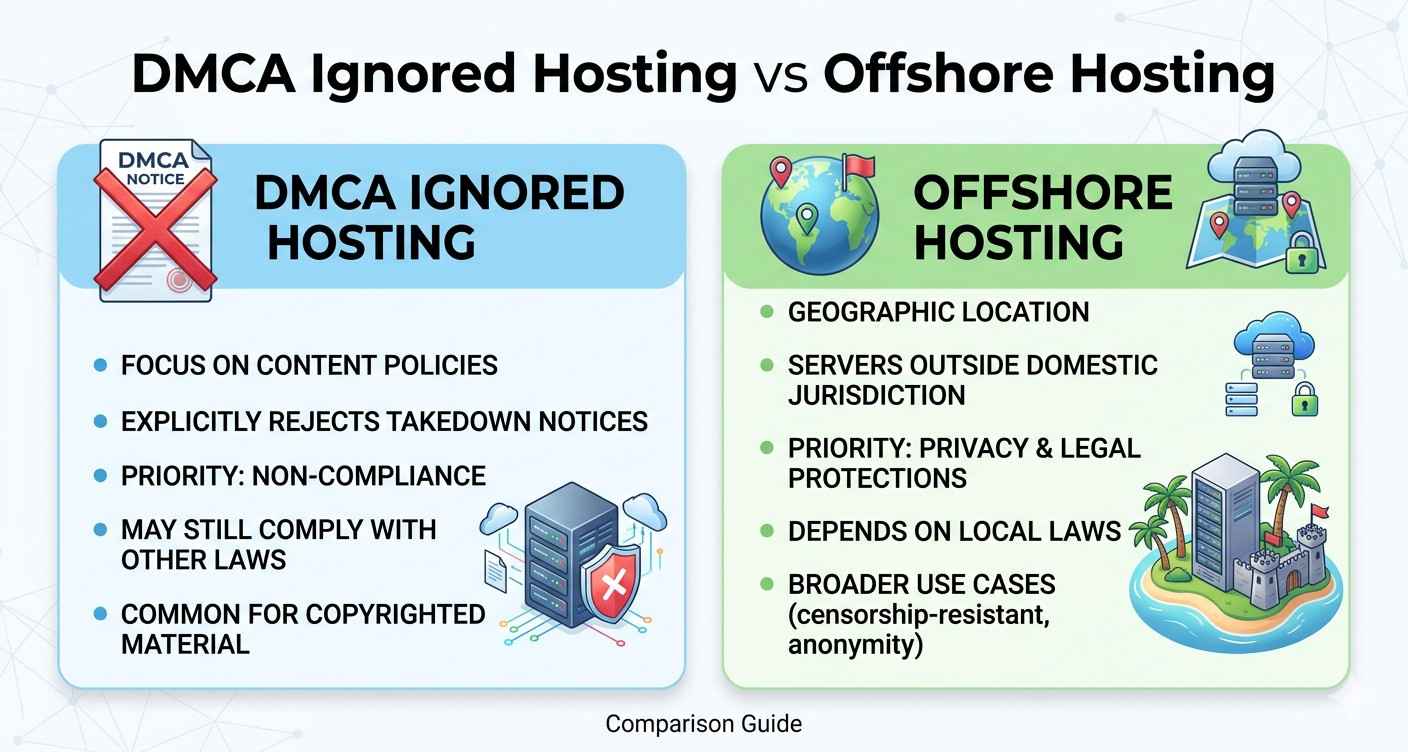
While the terms are often used together, DMCA Ignored hosting and Offshore hosting are not the same thing. The key distinction lies in their primary purpose. DMCA Ignored hosting specifically focuses on not complying with copyright takedown requests. Offshore hosting, on the other hand, is about locating your data in a different country, often for broader benefits like data protection or freedom of speech.
It’s true that most DMCA Ignored hosting is also offshore hosting, as this is how providers avoid U.S. copyright laws. However, not all offshore hosting ignores DMCA requests. A hosting provider in Canada, for instance, would be offshore for a U.S. client but would still likely comply with DMCA notices. Let’s explore the differences in location, legal implications, and use cases.
Location, Legal Implications, and Content Policies
The most significant distinction between DMCA Ignored hosting and Offshore hosting comes down to their legal standing and content policies. DMCA Ignored hosting services are almost always located offshore in countries with more relaxed copyright enforcement, such as Russia, the Netherlands, or Malaysia. This location is a core part of their strategy to legally ignore U.S. copyright laws. Their entire model is built around providing content freedom from DMCA takedowns.
Offshore hosting is a broader category. A provider is considered “offshore” simply because it’s outside your home country. It may be located in a country with strict copyright laws, but chosen for other advantages like stronger privacy protections or better data security regulations. Therefore, an offshore hosting provider does not automatically ignore DMCA requests—it depends on the local laws and the provider’s own terms of service.
This means that while using a DMCA Ignored hosting provider offers a layer of protection against takedown notices, it does not remove all legal risks. Copyright holders can still pursue legal action. The key difference is how the hosting provider responds to copyright claims.
| Feature | DMCA Ignored Hosting | Offshore Hosting |
|---|---|---|
| Primary Goal | To ignore DMCA takedown notices and allow content freedom | To host data in a foreign country for privacy, security, or legal benefits |
| Location | Typically in countries with relaxed copyright enforcement (e.g., Russia, Netherlands) | Any country outside the user’s home country |
| DMCA Compliance | Intentionally non-compliant with DMCA requests | Depends on local laws and provider policy |
| Legal Focus | Protection against copyright claims and forced content removal | Broader benefits like data protection, freedom of expression, and jurisdictional flexibility |
Business Use Cases and Who Benefits Most
The choice between DMCA Ignored hosting and Offshore hosting depends on your specific use case. DMCA Ignored hosting is a targeted solution for websites that regularly face copyright complaints. It helps maintain uptime and reduces disruptions caused by frequent takedown requests.
Offshore hosting, in contrast, serves a wider range of users. It is suitable for anyone looking to benefit from privacy-focused jurisdictions, data protection laws, or operating under a different legal framework.
Here’s who typically benefits most from each:
- DMCA Ignored Hosting
Ideal for streaming platforms, file-sharing websites, adult content sites, and political or activist blogs that want to avoid repeated DMCA takedowns. - Offshore Hosting
Suitable for journalists, whistleblowers, businesses seeking stronger data privacy, and website owners who want more control over their legal environment and content policies.
Conclusion
Understanding the differences between DMCA Ignored hosting and Offshore hosting is essential for website owners who want to protect their content and manage legal exposure more effectively. While DMCA Ignored hosting focuses on resisting DMCA takedown requests, Offshore hosting provides flexibility by placing your data under a different legal jurisdiction with its own privacy and copyright laws.
The right choice depends on your content type, risk tolerance, and long-term goals. If your priority is reducing disruptions from copyright claims, DMCA Ignored hosting may be the better fit. If you’re looking for broader advantages like data protection, privacy, and jurisdictional control, Offshore hosting offers a more flexible approach.
By aligning your hosting strategy with your specific use case, you can maintain better control over your website, reduce unexpected downtime, and operate within a legal framework that supports your needs.
Frequently Asked Questions
Are DMCA ignored hosting services always offshore?
Yes, for all practical purposes, DMCA ignored hosting services must be offshore. A hosting provider needs to operate in a legal environment outside of U.S. jurisdiction to legally ignore American copyright laws like the DMCA. Their offshore location is what enables their non-compliance policy.
What are the risks and legal consequences of DMCA ignored hosting?
While the hosting provider ignores copyright complaints, you are not immune to legal consequences. Copyright holders can still file lawsuits, or your domain name could be seized. Furthermore, search engines might de-index your site for hosting pirated material, impacting your reputation and traffic.
Can you host all types of content with offshore hosting?
No, even offshore hosting has limits. While it offers more content freedom than regular hosting, nearly every hosting provider, regardless of location, will prohibit illegal content. This includes materials related to terrorism, child exploitation, and phishing scams. Always check the provider's terms of service.
Is DMCA Ignored hosting completely legal?
DMCA Ignored hosting operates legally within its own jurisdiction, but it does not make you immune to copyright laws. Legal action can still be taken outside the hosting provider.
Is Offshore hosting better for privacy?
Yes, many offshore hosting providers offer stronger data privacy protections, especially in countries with strict privacy laws and flexible regulations.