Community servers are seeing a strong resurgence because players want more control, better social experiences, and consistent gameplay environments. Unlike automated matchmaking systems, community servers let players choose where they play, who they play with, and how the game is run. This shift is driven by growing frustration with toxic lobbies, lack of customization, and short-lived match experiences.
In 2026, multiplayer gaming is no longer just about quick matches—it’s about belonging to a space that feels familiar. Private game servers, modded servers, and player-run communities are filling that gap by offering stability, identity, and long-term engagement.
This article explains exactly why gamers are returning to community servers, what makes them different, and how they are shaping the future of online multiplayer games.
What Are Community Servers and How Do They Work?
Community servers are player-hosted or privately managed multiplayer servers where the rules, settings, and overall experience are controlled by individuals or groups instead of the game developer. Unlike centralized matchmaking, these servers give players direct access to specific environments through a server browser or invite system.
Here’s how community servers typically work:
- A player, group, or organization sets up a dedicated server for gaming
- Server admins define rules, maps, and gameplay settings
- Mods or plugins can be added to customize the experience
- Players join manually via server lists or direct IP
- Admins actively monitor and manage player behavior
This structure allows for a more tailored experience compared to matchmaking systems, where players are automatically placed into random lobbies.
Key Features of Community Servers
- Full control over gameplay rules (friendly fire, map rotation, game modes)
- Custom mods and content that change how the game is played
- Active moderation by real admins instead of automated systems
- Persistent communities where players recognize each other
- Flexible server types, from casual to competitive to roleplay
Community Servers vs Dedicated Servers vs Matchmaking
While often used interchangeably, these terms have important differences:
- Community servers: Player-run, customizable, socially driven
- Dedicated servers: Technical infrastructure (can power community servers)
- Matchmaking systems: Developer-controlled, automated player placement
Understanding this difference is important because community servers combine the power of dedicated infrastructure with the flexibility of player control—something matchmaking cannot offer.
For players who want more than quick matches, this model creates a deeper and more consistent multiplayer experience.
Why Gamers Are Moving Back to Community Servers
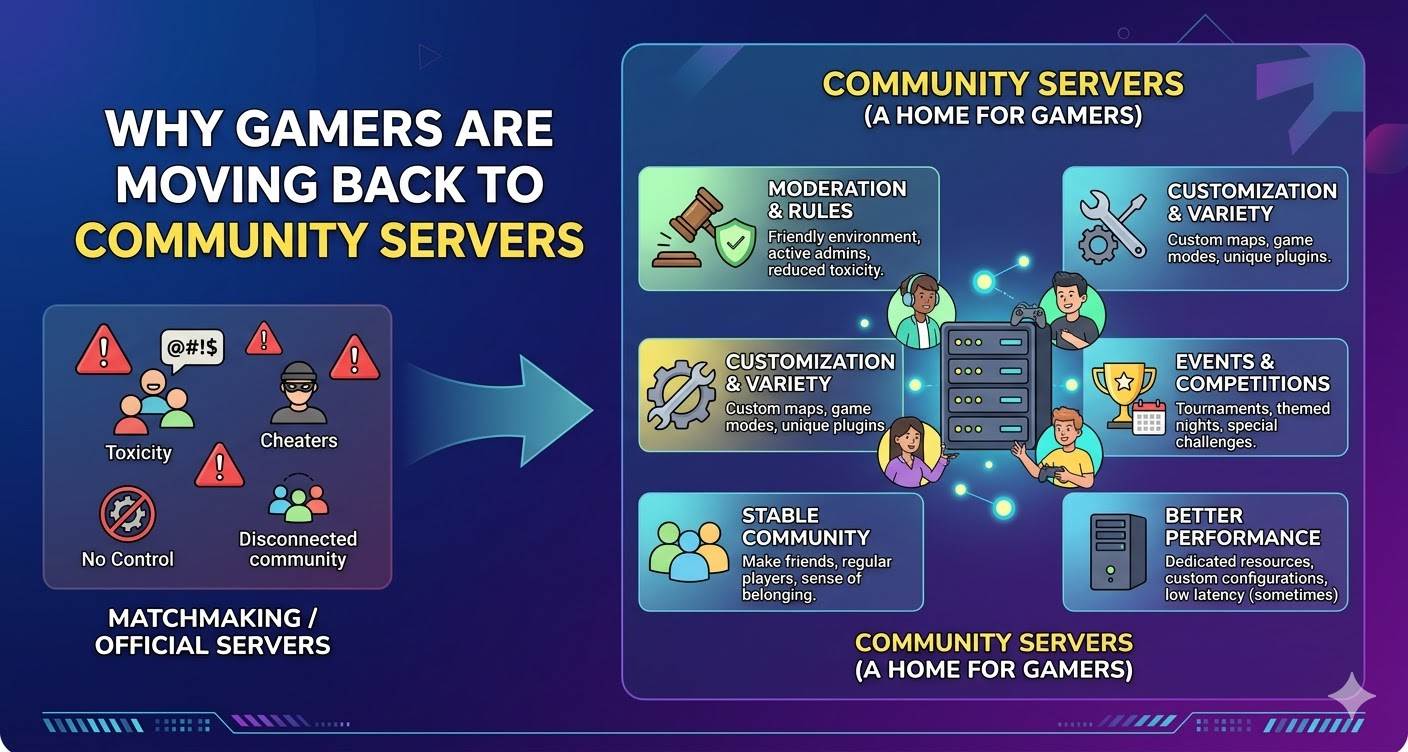
The return of community servers isn’t random—it’s a direct response to gaps in modern multiplayer systems. Players are choosing environments where they have control, consistency, and real interaction instead of short, disposable matches.
Here are the main reasons driving this shift:
1. More Control Over Gameplay
Matchmaking systems decide everything for the player—from teammates to maps. That lack of control leads to inconsistent experiences.
With community servers, players can:
- Choose specific maps or modes
- Join servers that match their playstyle
- Avoid unwanted rules or mechanics
This makes every session more predictable and enjoyable.
2. Better Moderation and Fair Play
Automated moderation often fails to handle toxic behavior effectively. Reports can take time, and enforcement is inconsistent.
Community servers solve this through:
- Active human admins
- Immediate rule enforcement
- Clear community guidelines
As a result, players experience fewer disruptions and a more balanced environment.
3. Real Communities Instead of Random Lobbies
One of the biggest differences is the social layer. Matchmaking creates temporary interactions, while player-run servers build long-term connections.
On community servers, players:
- Recognize regulars
- Build friendships
- Return to the same server daily
This creates a sense of belonging that matchmaking cannot replicate.
4. Customization Through Mods and Unique Rules
Modded servers are a major reason players return to community-based gameplay. They allow experiences that don’t exist in the base game.
Examples include:
- Custom maps and weapons
- Roleplay servers with structured rules
- Hardcore or survival-focused gameplay
This variety keeps games interesting long after their release.
5. Longer Game Lifespan
Games supported by community servers tend to stay active for years.
Why this happens:
- Communities keep players engaged
- Mods introduce new content
- Servers evolve based on player feedback
This extends the life of games far beyond what standard matchmaking systems can support.
6. Less Focus on Monetization
Many modern multiplayer games emphasize microtransactions and seasonal content. This can affect gameplay balance and player experience.
Community servers shift the focus back to gameplay by:
- Removing pay-to-win elements
- Prioritizing fun over progression systems
- Allowing players to define their own experience
7. Freedom to Choose Where and How You Play
Server browsers give players full visibility and choice. Instead of being placed into random matches, they can:
- Filter servers by region, ping, or rules
- Join communities that match their preferences
- Leave and switch servers instantly
This freedom is one of the biggest reasons community servers are gaining traction again.
Community Servers vs Matchmaking: What’s the Real Difference?
Understanding the difference between community servers and matchmaking systems helps explain why many players are switching back. Both models serve a purpose, but they create very different multiplayer experiences.
Quick Comparison
| Feature | Community Servers | Matchmaking Systems |
|---|---|---|
| Player Control | High — choose server, rules, and environment | Low — system decides everything |
| Moderation | Active admins and community rules | Automated reporting systems |
| Social Experience | Persistent communities | Temporary interactions |
| Customization | Mods, plugins, custom modes | Limited or none |
| Game Variety | Unique server experiences | Standardized gameplay |
| Player Retention | Long-term engagement | Short session-based play |
How Matchmaking Systems Work
Matchmaking systems are designed for speed and accessibility. Players queue up and are placed into matches automatically based on factors like skill level or region.
This approach works well for:
- Fast game sessions
- Competitive ranking systems
- New player onboarding
However, it often leads to:
- Inconsistent team quality
- Limited control over gameplay
- Repetitive experiences
How Community Servers Work Differently
Community servers give players direct access to curated environments instead of random placement.
Key differences include:
- Players manually select servers using a browser
- Admins enforce rules in real time
- Servers often cater to specific playstyles (casual, competitive, roleplay)
This creates a more stable and personalized experience.
Which One Is Better for Players?
It depends on what the player wants:
Choose matchmaking if you want:
- Quick access to games
- Competitive ranking systems
- Minimal setup
Choose community servers if you want:
- Consistent gameplay environments
- Strong communities and social interaction
- Custom or modded experiences
Why Many Players Prefer Community Servers Today
The shift back to community servers is happening because players are prioritizing quality over convenience. While matchmaking offers speed, it often lacks depth and connection.
Community servers bring back:
- Familiar players and recurring interactions
- Gameplay variety through customization
- A sense of ownership within the game
For many gamers in 2026, that trade-off is worth it.
Who Should Choose Community Servers? (Use Cases That Fit Best)
Not every player needs community servers, but for many, they offer a better overall experience than standard matchmaking. The key is understanding which type of player benefits most from this model.
1. Players Who Want Consistency
If you’re tired of unpredictable matches, community servers provide a stable environment.
You’ll benefit if you:
- Prefer familiar maps and rules
- Want consistent gameplay quality
- Like playing with regulars instead of random teammates
2. Gamers Looking for Strong Communities
For players who value social interaction, player-run servers create a sense of belonging that matchmaking cannot match.
This is ideal if you:
- Enjoy recognizing the same players
- Want to build friendships in-game
- Prefer community-driven events or activities
3. Fans of Modded or Custom Gameplay
If standard gameplay feels repetitive, modded servers open up entirely new experiences.
You should consider community servers if you want:
- Custom game modes
- Unique rules or mechanics
- Creative or experimental gameplay setups
4. Competitive Players Who Want Fair Environments
While matchmaking focuses on ranking systems, it doesn’t always guarantee fair or balanced matches.
Community servers can offer:
- Strict rule enforcement
- Balanced gameplay settings
- Admin oversight to prevent cheating or griefing
5. Content Creators and Streamers
Many creators prefer community servers because they allow direct interaction with their audience.
Benefits include:
- Hosting private or subscriber-only servers
- Building a dedicated community
- Creating unique content experiences
6. Players Who Want to Avoid Toxicity
Toxic behavior is a major issue in online gaming. Community servers address this with active moderation.
You’ll notice:
- Faster action against rule-breakers
- Clear behavioral expectations
- More respectful player interactions
When Matchmaking Might Still Be the Better Option
Even with the rise of community servers, matchmaking still works well in certain situations:
- When you have limited time and need quick matches
- When you want ranked or competitive progression
- When a game doesn’t support server browsers
Challenges of Community Servers (What to Know Before You Join)
While community servers offer clear advantages, they are not without drawbacks. Understanding these challenges helps set realistic expectations and ensures you choose the right servers for your needs.
1. Finding the Right Server Takes Time
Unlike matchmaking, where you join instantly, community servers require manual selection.
Players often need to:
- Browse multiple servers
- Test different communities
- Check rules and player activity
This process can take time, especially for new players.
2. Quality Varies Between Servers
Not all player-run servers are well managed. Some may have:
- Inactive or biased admins
- Poor rule enforcement
- Low player activity
The experience depends heavily on how the server is run.
3. Smaller Player Pools in Niche Servers
Highly customized or modded servers can attract smaller audiences.
This may result in:
- Longer wait times for active matches
- Limited peak hours
- Fewer players in specific regions
However, active communities often offset this with loyal player bases.
4. Learning Curve for New Players
For players used to matchmaking, switching to community servers can feel unfamiliar.
They may need to learn:
- How server browsers work
- Differences in rules across servers
- How mods or custom settings affect gameplay
5. Potential Costs for Premium Servers
While many private game servers are free to join, some communities charge for:
- VIP access
- Reserved slots
- Additional features
These costs are usually optional but can influence the experience.
How to Choose the Right Community Server
To avoid a poor experience, look for servers that offer:
- Active admins and clear rules
- Consistent player activity
- Positive community reputation
- Stable performance and low latency
Spending a little time upfront can make a big difference in long-term enjoyment.
The Future of Community Servers in Online Gaming
The resurgence of community servers is not a short-term trend. It reflects a shift in what players expect from multiplayer games—more control, stronger communities, and longer-lasting experiences.
Hybrid Multiplayer Models Are Emerging
Many developers are no longer choosing between matchmaking and community servers. Instead, they are combining both systems.
This hybrid approach allows:
- Quick matchmaking for instant play
- Community servers for long-term engagement
- Greater flexibility for different player types
Games that support both tend to retain players longer because they cater to multiple playstyles.
Server Browsers Are Returning
One clear signal of this shift is the return of server browsers.
Modern games are starting to include:
- Advanced filtering (ping, region, rules)
- Visibility into active communities
- Easy access to private game servers
This gives players more choice instead of forcing them into automated systems.
Modding Support Is Becoming a Priority
Developers are recognizing the value of modded servers in extending a game’s lifespan.
As a result, more games are:
- Releasing modding tools
- Supporting custom content
- Encouraging community-driven innovation
This approach keeps games relevant long after launch.
Community-Driven Ecosystems Will Grow
The success of player-run servers shows that players want ownership in their gaming experience.
In the future, expect:
- More creator-led servers
- Stronger community identities
- Events and content driven by players
This shifts multiplayer gaming from a developer-controlled model to a shared ecosystem.
Why Developers Are Paying Attention
Developers are starting to see the long-term value of community servers:
- Higher player retention
- Organic community growth
- Reduced reliance on constant content updates
Supporting community servers can extend a game’s lifecycle without requiring continuous developer intervention.
Conclusion: Why Community Servers Are Back for Good
The return of community servers highlights a clear shift in what players want from multiplayer gaming. Speed and convenience brought by matchmaking systems are no longer enough on their own. Players are looking for control, consistency, and meaningful interaction—and that’s exactly what community-driven environments provide.
By giving players the ability to choose their servers, shape the rules, and build lasting connections, community servers bring back the social side of gaming that many felt was missing. They also extend the life of games through customization, mods, and active communities that keep experiences fresh over time.
Matchmaking will still have its place, especially for quick sessions and competitive play. But for players who want more than just another random match, community servers offer a deeper and more rewarding way to play.
As more developers support server browsers, modding, and private hosting, this model will continue to grow. For many gamers in 2026 and beyond, community servers are not just an alternative—they are becoming the preferred way to experience multiplayer games.
FAQ: Community Servers Explained (For Gamers in 2026
What are community servers in gaming?
Community servers are player-hosted or privately managed servers where gameplay rules, maps, and moderation are controlled by admins or communities instead of the game developer. They allow players to choose specific environments rather than being placed into random matches.
Why are gamers switching to community servers?
Gamers are switching to community servers for better control, stronger communities, and more consistent gameplay. These servers reduce toxicity, support custom content, and create long-term social experiences that matchmaking often lacks.
Are community servers better than matchmaking systems?
Community servers are better for customization, social interaction, and long-term engagement. Matchmaking systems are better for quick access and competitive ranking. The best option depends on how you prefer to play.
Do community servers support mods and custom content?
Yes, most modded servers allow custom maps, gameplay changes, and unique rules. This is one of the main reasons players return to community-based multiplayer environments.
Are community servers safe to join?
Most player-run servers are safe if they have active moderation and clear rules. It’s best to join servers with good reputations and consistent admin presence.
Do you need to pay to use community servers?
Many private game servers are free, but some offer optional paid perks like VIP access or reserved slots. These are usually not required to enjoy the core experience.