Choosing a cloud hosting provider is not just a technical decision—it directly affects your site speed, uptime, security, and long-term operating costs. Many businesses move to the cloud expecting better performance and flexibility, but the results depend entirely on the features their provider actually delivers.
Not all cloud platforms are built the same. Some focus on low-cost infrastructure with limited support, while others prioritize security, compliance, and managed services. The challenge is knowing which features matter before you commit—because switching providers later can be complex and expensive.
This guide breaks down the core features every business cloud hosting provider should include. Instead of marketing claims, you’ll see practical criteria you can use to evaluate options and avoid common mistakes.
Whether you’re running a growing SaaS platform, an e-commerce store, or internal business applications, the goal is simple: choose a cloud environment that keeps your systems reliable, secure, and ready to scale.
If you’re currently comparing providers, this article will help you identify what to look for—and what to avoid—so you can make a decision with confidence.
Why the Right Cloud Hosting Features Matter for Your Business?
Choosing a cloud hosting provider is not just about where your applications run—it directly affects performance, uptime, security, and long-term costs.
Many businesses move to the cloud expecting better reliability, but problems often come from missing or weak features. Slow load times, unexpected downtime, and security gaps are usually the result of poor infrastructure choices, not the cloud itself.
The right set of features helps you:
Keep your applications online and responsive
Protect sensitive data from threats
Scale resources as your business grows
Control costs with clear pricing
Avoid technical limitations that slow down operations
On the other hand, choosing a provider without these core capabilities can lead to constant troubleshooting, higher expenses, and a poor user experience.
This is why evaluating cloud hosting features upfront is critical—it saves time, reduces risk, and supports long-term growth.
Top Cloud Hosting Features Every Business Should Prioritize
When evaluating a cloud hosting provider, focus on features that directly impact security, uptime, scalability, and long-term costs. Below are the core capabilities every business should expect from a reliable cloud platform.
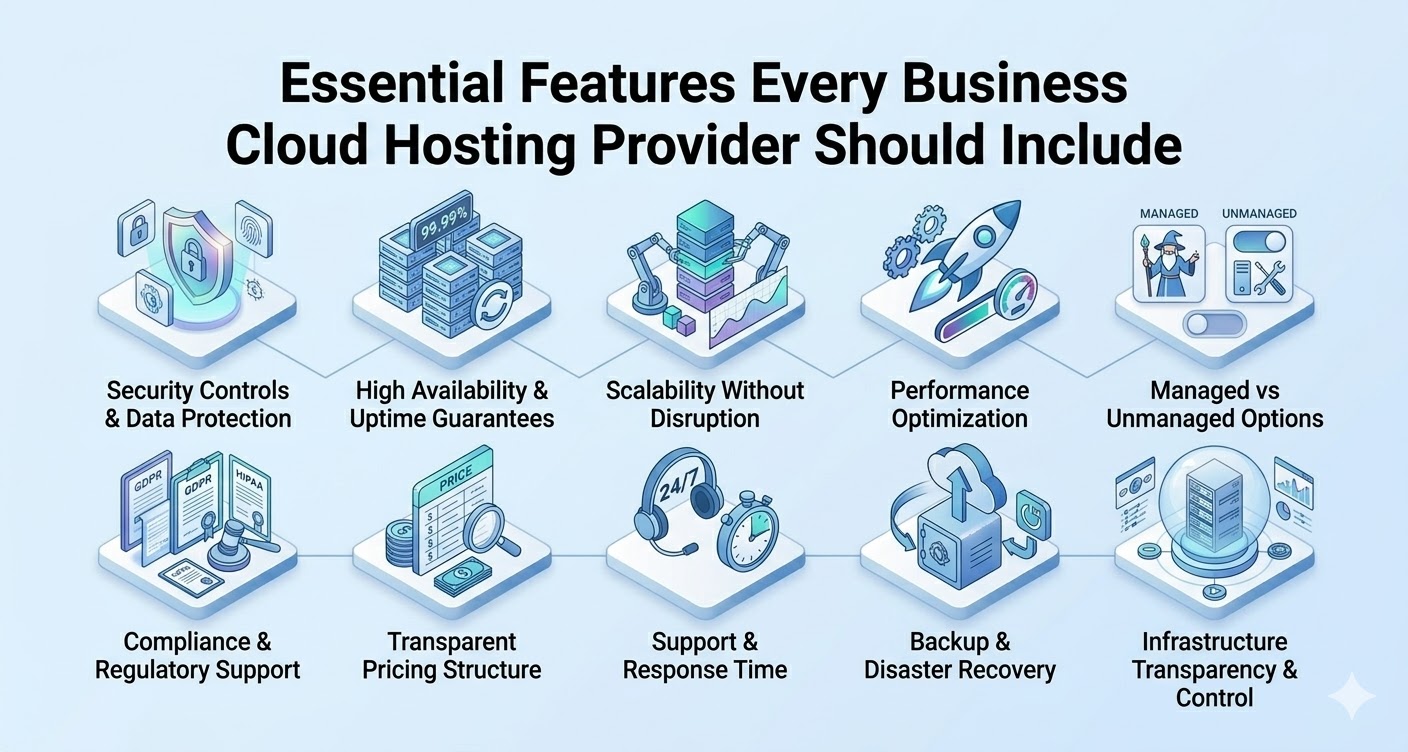
1. Security Controls and Data Protection
Security is the baseline requirement. If your data is not protected, nothing else matters.
What to look for:
Network protection (firewalls, DDoS mitigation)
Encryption for data in transit and at rest
Role-based access controls
Built-in backup and recovery options
Real-time monitoring and threat alerts
Best for: Businesses handling sensitive data such as healthcare, finance, or customer information.
Providers like Atlantic.Net are often evaluated when strong security and compliance support are required, especially for regulated environments.
2. High Availability and Uptime Guarantees
Downtime affects revenue, operations, and customer trust.
Key indicators:
SLA-backed uptime (99.9% or higher)
Multiple data center locations
Automatic failover systems
Redundant infrastructure
Best for: E-commerce, SaaS platforms, and applications that require continuous availability.
Don’t just check the SLA—understand how uptime is maintained.
3. Scalability Without Downtime
Your infrastructure should support growth without disruption.
Must-have capabilities:
Vertical scaling (increase resources instantly)
Horizontal scaling (add servers as needed)
Load balancing
Auto-scaling based on demand
Best for: Startups, SaaS businesses, and platforms with variable traffic.
If scaling requires downtime or manual changes, it limits growth.
4. Performance Optimization
Performance affects both user experience and search visibility.
Key performance factors:
SSD or NVMe-based storage
CDN integration for faster content delivery
Low-latency network infrastructure
Resource isolation to prevent performance issues
Best for: Websites, applications, and APIs where speed impacts engagement or conversions.
Faster infrastructure improves user retention and supports SEO performance.
5. Managed vs. Unmanaged Hosting Options
Choose a model that fits your technical capabilities.
Two main options:
Managed hosting: Provider handles maintenance, updates, and monitoring
Unmanaged hosting: Full control over configuration and management
Best for:
Managed → small teams or non-technical businesses
Unmanaged → experienced developers and DevOps teams
Select based on your internal resources, not just pricing.
6. Compliance and Regulatory Support
For regulated industries, compliance is mandatory.
Common standards:
HIPAA (healthcare)
PCI DSS (payments)
SOC 2 (data security practices)
GDPR (data privacy regulations)
Best for: Healthcare, fintech, SaaS, and businesses handling user data.
Your provider should support compliance at the infrastructure level.
7. Transparent Pricing Structure
Unexpected costs can quickly add up in cloud environments.
Watch for:
Bandwidth and data transfer fees
Storage overages
Backup and recovery costs
Support charges
Scaling-related pricing
Best for: Businesses that need predictable monthly expenses.
Clear pricing helps avoid surprises as your usage grows.
8. Support and Response Time
Reliable support becomes critical during outages or migrations.
What to evaluate:
24/7 support availability
Defined response times
Access to qualified engineers
Tiered support plans
Best for: Businesses without dedicated infrastructure teams.
Test support responsiveness before making a decision.
9. Backup and Disaster Recovery
Data loss can disrupt operations and damage trust.
Required capabilities:
Automated backups
Point-in-time recovery
Off-site backup storage
Fast and simple restoration
Best for: Any business relying on data for daily operations.
Backups should be easy to manage and quick to restore.
10. Infrastructure Transparency and Control
You should have clear visibility into your environment.
Look for:
Real-time resource monitoring
Control over configurations
API access for automation
Detailed dashboards and reporting
Best for: Businesses that require control over deployment and performance.
Lack of visibility makes troubleshooting and optimization difficult.
Comparison: Key Cloud Hosting Features at a Glance
| Feature | Why It Matters | Minimum Expectation |
|---|---|---|
| Security | Protects data and systems | Encryption + firewall |
| Uptime | Keeps services online | 99.9% SLA |
| Scalability | Supports growth | On-demand scaling |
| Performance | Impacts speed and UX | SSD + low latency |
| Support | Resolves issues fast | 24/7 availability |
| Compliance | Meets legal standards | Industry-specific support |
| Pricing | Controls costs | Transparent billing |
| Backups | Prevents data loss | Automated backups |
How to Evaluate a Cloud Hosting Provider (Checklist for Businesses)
Choosing a cloud hosting provider requires more than comparing prices or brand names. The goal is to assess whether the platform can support your business reliably as it grows.
Use this checklist to evaluate any provider before making a decision:
Does the provider clearly explain their security setup?
Look for transparency around encryption, firewalls, access control, and monitoring—not vague claims.Can you scale resources without downtime or manual intervention?
The platform should allow instant scaling (CPU, RAM, storage) without disrupting your applications.Are pricing details clear and predictable upfront?
Check for hidden costs related to bandwidth, backups, support, or scaling.Is 24/7 support available with access to real engineers?
During critical issues, fast access to knowledgeable support makes a major difference.Are backups automated and easy to restore?
You should be able to recover data quickly without complex processes.Does the provider support your compliance requirements?
This is critical for industries like healthcare, finance, and SaaS handling user data.
Common Mistakes to Avoid When Choosing Cloud Hosting
Many businesses face issues not because of cloud hosting itself, but because of how they choose their provider. Avoid these common mistakes to prevent long-term problems.
Choosing Based on Price Alone
Low-cost hosting may seem attractive, but it often comes with trade-offs in performance, uptime, and support.
Limited resources can slow down applications
Support may be slow or unavailable
Extra costs may appear later
Better approach: Focus on value, not just price.
Ignoring Scalability Early
Some providers make scaling difficult or require manual upgrades.
You may experience downtime during traffic spikes
Growth can be limited by infrastructure constraints
Better approach: Choose a provider that allows on-demand scaling from day one.
Overlooking Support Quality
Support is often ignored until something breaks.
Delayed responses can extend downtime
Lack of technical expertise slows issue resolution
Better approach: Test support responsiveness before committing.
Not Planning for Compliance
Compliance is often treated as an afterthought—but fixing it later is expensive.
You may need to migrate infrastructure
Additional audits and changes increase costs
Better approach: Choose a provider that aligns with your compliance needs from the start.
FAQs
Security, uptime, scalability, performance, support, and transparent pricing. Match the provider’s features with your needs—check security, scalability, support, and pricing clarity. Yes—if pricing is transparent. Watch for hidden fees like bandwidth and storage. It lets you handle traffic growth without downtime or performance issues. Encryption, firewalls, access control, monitoring, and automated backups. Higher uptime means fewer outages, better user experience, and less revenue loss. 1. What are the most important features in a business cloud hosting provider?
2. How do I choose the right cloud hosting provider?
3. Are cloud hosting costs predictable?
4. Why is scalability important in cloud hosting?
5. What security features should a cloud hosting provider include?
6. How does uptime affect my business?